Choosing Stainless Steel T-Bar Cabinet Pulls in 2026 involves more than matching a trendy finish. The right pull should fit the cabinet door, hand, room, and daily routine. It must feel comfortable at six in the morning, not only look attractive in a product photograph.
Interior hardware specialist Peter Sallick once said, “Good hardware should invite touch before it demands attention.” That idea remains useful when comparing T-bar lengths, mounting centers, and stainless steel grades. A 96 mm pull may suit a narrow drawer, while a 160 mm bar can look more balanced on wide pantry doors. Measure carefully. Small errors become obvious across a full kitchen.
Look closely at the finish, too. Brushed stainless steel can hide fingerprints and minor scratches better than a polished surface. Solid construction usually feels steadier than lightweight hollow tubing. Check the screw length, thread quality, and return policy before ordering. These details are easy to overlook.
Style still matters. A slim bar can sharpen flat-panel cabinets, while a thicker profile may suit shaker doors. Yet “modern” does not always mean minimal. Sometimes, the cleanest kitchen needs warmer proportions or a slightly softer edge. That is where personal judgment becomes important.
I would not choose solely from a screen. Request a sample, hold it against the cabinet, and test the grip with wet hands. Screens deceive. Even experienced buyers misjudge scale occasionally. This guide will help you compare Stainless Steel T-Bar Cabinet Pulls with greater confidence, while leaving room for practical reflection.
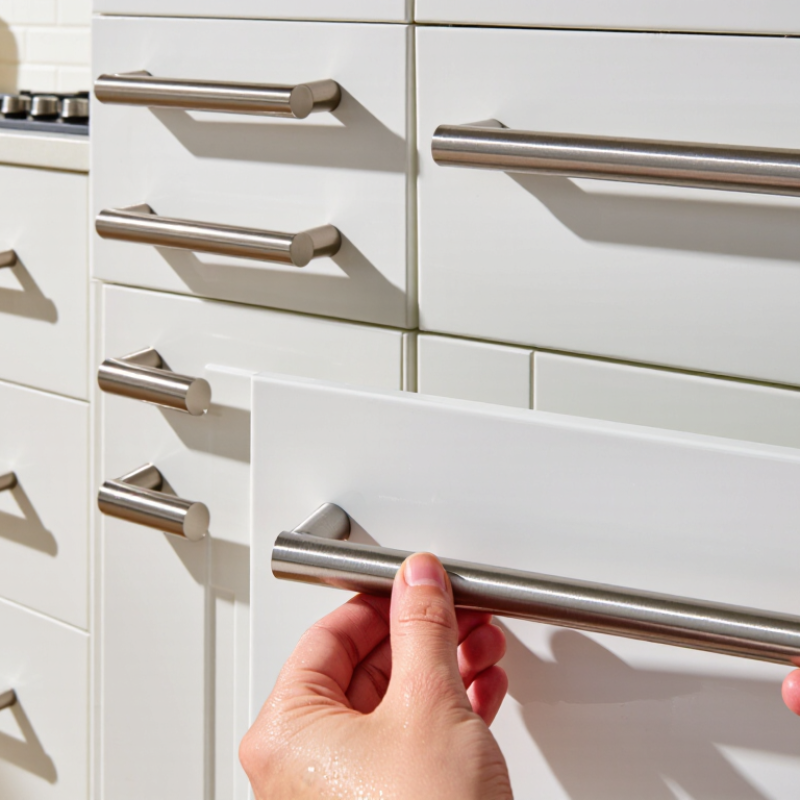
Stainless steel T bar cabinet pulls are handles with a straight grip and two mounting posts. Their shape resembles the letter T when viewed from the front. The bar gives fingers a clear, comfortable gripping area. Stainless steel also resists moisture, stains, and everyday kitchen wear. A brushed surface can hide fingerprints better than a mirror finish. That difference matters on frequently used drawers.
Choosing one in 2026 requires more than matching a trendy color. Check the steel grade when product information is available. Grade 304 suits most indoor kitchens and bathrooms. Grade 316 offers stronger corrosion resistance in damp or coastal environments.
Measure the center-to-center hole distance before ordering. A beautiful pull is useless if its screw spacing does not match the cabinet.
Hold a sample if possible. Sharp edges can feel unpleasant after repeated use. The bar should leave enough space for knuckles, especially on thick doors. Longer pulls can make wide drawers easier to open, but they may look oversized on narrow fronts. I would not trust photographs alone. Lighting can disguise surface marks and uneven finishing. Even small inconsistencies become visible under bright cabinet lighting. My own selection process would include checking screw length, grip diameter, and cleaning instructions before installation.
For stainless steel T bar cabinet pulls, grade matters more than a glossy photograph suggests. The World Stainless Association reported 58.4 million tonnes of stainless crude steel production in 2023, up 4.6% year on year. That scale reflects broad demand, but not every grade suits a kitchen. Grade 304 is a dependable choice for most indoor cabinets. It resists household moisture and keeps a clean appearance. Near coastlines, pools, or salt-heavy kitchens, grade 316 offers stronger chloride resistance. Grade 430 can work in dry interiors, yet it generally provides less corrosion resistance than 304.
Finish changes daily maintenance. Brushed or satin surfaces soften fingerprints and disguise small scratches around frequently used drawers. Polished finishes reflect more light, but they reveal smudges quickly. Very quickly. The Euro Inox care guidance explains that smoother stainless surfaces are easier to clean, while rougher surfaces can hold contaminants. Still, a deep directional brushing pattern may collect dust along its grain. That detail is easy to miss.
Polished finishes reflect more light, but they reveal smudges quickly. Very quickly.
Ask for the actual grade, not only “stainless steel.” Check whether the pull uses solid stainless steel or a plated base metal. The ASTM A240 specification covers common stainless sheet and plate grades, but hardware quality still depends on forming, welding, and polishing. For a coastal home, I would choose 316 with a fine satin finish. For a dry bedroom, 304 with brushed finishing is usually sensible. My own selection would avoid mirror polish unless the cleaning routine is realistic. A beautiful pull becomes disappointing when every touch leaves evidence.
Choosing stainless steel T bar cabinet pulls starts with the cabinet’s scale, not personal preference. Measure the door or drawer front before browsing sizes. For most standard drawers, a pull with 3 to 5 inches between screw centers feels balanced. Larger drawers often need 6 to 10 inches for easier leverage. Measure center to center, not the total bar length.
Spacing matters as much as pull size. Leave enough room for your fingers without allowing the pull to collide with nearby doors. On paired cabinet doors, keep the pulls at equal heights and mirror their positions. A simple cardboard template can reveal mistakes before drilling. Mark the holes with removable tape and test the grip at standing height. Stainless steel shows fingerprints, so handle the sample with clean hands.
I once selected a long pull that looked elegant but felt awkward on a narrow drawer. It created a visual imbalance and caught on a nearby handle. That mistake changed my method. I now compare the pull with the cabinet width, edge profile, and surrounding hardware. Thin doors may need shorter screws, while thick drawers require accurate screw-length checks. A slightly imperfect mock-up is better than permanent holes in finished cabinetry. Consider daily use, too. A busy kitchen may benefit from a larger pull, even when a smaller size looks more delicate.
The chart shows commonly used cabinet-handle center-to-center spacings for different cabinet-front widths. The spacing is measured between the two mounting-hole centers, not the overall length of the T-bar pull. For a balanced appearance, choose a larger spacing for wider drawers and confirm the selected size against the cabinet’s available mounting area before drilling.
How to Choose Stainless Steel T Bar Cabinet Pulls in 2026?
What Mounting Style and Handle Shape Fit Your Cabinets?
Mounting style affects both stability and daily comfort. For drawers wider than 600 mm, choose a two-screw T bar with rear-through bolts. It spreads pulling force more evenly than a single-point knob. Back-mounted pulls also hide visible screw heads, creating a cleaner cabinet face. Check the manufacturer’s screw length before ordering. Thick doors may need longer bolts.
Handle shape matters at the first touch. A cylindrical bar feels familiar and suits shaker, slab, and transitional doors. A square-edged bar looks sharper, but its corners can feel uncomfortable during repeated use. For busy kitchens, select a gently rounded profile with at least 30 mm of finger clearance. Stainless steel resists corrosion, yet fingerprints still appear on polished finishes.
The Houzz 2024 U.S. Kitchen Trends Study reports that 76% of renovating homeowners upgraded cabinets. That figure shows why hardware deserves practical testing, not only visual matching. The National Kitchen & Bath Association’s 2024 Design Trends Report also identifies functional details as important in kitchen planning. Reports guide decisions, but real hand comfort can differ. I once preferred a slim bar, then found it tiring on a heavily loaded drawer.
Tips: Tape two handle shapes onto a sample door. Open the drawer repeatedly with wet or dry hands. Compare satin and polished steel under your actual lighting. Leave at least 50 mm between adjacent pulls and nearby cabinet edges.
Use this comparison to match stainless steel T-bar pulls with cabinet construction, door and drawer size, installation requirements, and the level of comfort needed for everyday use.
| Mounting Style | Typical Hole Pattern | Best Cabinet Application | Handle Shape and Comfort | Installation Considerations | Advantages | Potential Limitations |
|---|---|---|---|---|---|---|
| Single-Screw Center Mount | One central screw hole; commonly paired with a compact T-bar. | Small cabinet doors, narrow drawers, vanity units, and furniture with limited face width. | A short cylindrical bar with rounded ends provides a simple grip and low visual weight. | Easy to align and replace. The single hole must be drilled accurately to keep the pull centered. | Fast installation; flexible placement; useful for replacing knobs. | Less resistant to twisting on wide or heavily loaded drawers. |
| Two-Screw T-Bar Pull | Two mounting holes measured by center-to-center distance, such as 96 mm, 128 mm, or 160 mm. | Standard cabinet doors, medium drawers, kitchen base cabinets, and tall storage doors. | A straight round bar offers a familiar grip; a larger diameter generally feels more substantial. | Measure center-to-center spacing rather than the overall pull length. Use a drilling template for consistent alignment. | Stable under repeated pulling; broad size range; easy to coordinate across a room. | Requires two accurately positioned holes and may not cover old holes with a different spacing. |
| Through-Bolted Pull | Two or more screws pass through the cabinet front and are secured from the back. | Thick drawer fronts, wide drawers, pantry doors, and high-use cabinetry. | A medium-to-large cylindrical bar distributes pulling force across both mounting points. | Check front thickness and screw length. Rear screw heads should not interfere with drawer contents or internal hardware. | Strong mechanical connection; suitable for frequent use and heavier drawers. | More installation time; visible rear hardware may reduce internal clearance. |
| Backplate or Rosette Mount | Usually one or two concealed mounting points under a decorative base. | Traditional, transitional, or retrofit projects where the mounting area needs visual coverage. | A cylindrical T-bar combined with a round or rectangular base creates a more substantial appearance. | Confirm that the base fully covers existing holes and sits flat against the cabinet surface. | Can conceal minor surface marks or previous drill holes; adds visual detail. | More difficult to clean around the base; less suitable for minimalist cabinetry. |
| Surface-Mounted Pull | Fasteners attach directly through the cabinet face into the pull's mounting posts. | Most framed and frameless cabinet doors and drawer fronts with adequate rear access. | Round or oval bars are comfortable because the hand can wrap around the grip. | Verify clearance behind the front panel and use fasteners intended for the cabinet material. | Straightforward construction; durable when correctly fastened; widely compatible. | Improper screw length can damage the cabinet interior or leave the pull loose. |
| Edge or Profile Pull | Usually mounted along the top or side edge; hole spacing varies by design. | Contemporary slab doors, handleless-style kitchens, and narrow drawer fronts. | A slim rectangular, chamfered, or gently rounded profile creates a low-projection grip. | Measure the cabinet edge thickness and confirm that adjacent doors and drawers can open without collision. | Clean modern appearance; reduced projection; useful where a full T-bar feels visually heavy. | Less hand clearance than a standard T-bar; installation must follow the profile geometry. |
When comparing stainless steel T bar cabinet pulls, inspect more than the shine. Grade 304 stainless steel usually offers stronger corrosion resistance than lower-grade alternatives. Ask for the material specification, not just “stainless steel.” Check the pull’s thickness, mounting threads, and hole alignment. A solid, evenly finished bar should feel balanced in your hand. Sharp edges, uneven welds, or loose screws suggest weak quality. I once judged a pull by its polished surface alone. That was too optimistic.
Maintenance affects long-term value. Stainless steel resists moisture, but it still shows fingerprints, especially on dark or mirror finishes. Wipe handles with warm water and mild dish soap, then dry them with a soft cloth. Avoid abrasive pads and chlorine-based cleaners. In a busy kitchen, this may take less than a minute daily. Brushed finishes often hide small marks better than polished ones. However, brushing can still collect grease along its fine lines.
Tips: Compare the complete cost, including screws, templates, installation time, and possible replacements. Measure each cabinet before ordering. A cheaper pull can become expensive when holes do not align. Request a sample if the finish must match appliances or lighting. Keep one spare handle; small hardware is easy to damage during moving or renovation. My own cost estimate often misses installation time, so I now record every step before choosing.
They are straight cabinet handles with two mounting posts. The bar creates a clear gripping space for fingers. Simple and practical.
Grade 304 usually suits kitchens, bathrooms, and bedrooms. Grade 316 offers stronger corrosion resistance near coastlines or salty environments. Grade 430 may suit dry interiors, but it resists corrosion less effectively.
Brushed or satin finishes usually hide fingerprints and small scratches better. Polished finishes reflect more light but show smudges quickly. Very quickly.
Measure the distance between screw centers, not the complete bar length. Common drawer spacing ranges from 3 to 5 inches. Larger drawers may need 6 to 10 inches. Measure twice.
Match the pull to the drawer or door width. Long pulls can improve leverage on wide drawers. They may look oversized on narrow fronts. Scale matters.
Make a cardboard template and mark the holes with removable tape. Hold it at standing height before making permanent holes. A rough mock-up prevents expensive mistakes.
Check whether the pull is solid stainless steel or plated base metal. Confirm screw length, grip diameter, edge smoothness, and cleaning instructions. Photographs can hide uneven finishing.
They suit many indoor cabinets, but surrounding space still matters. Leave enough room for knuckles and nearby doors. Thick doors may require longer screws. I once chose a long pull that caught a nearby handle.
Choosing Stainless Steel T-Bar Cabinet Pulls in 2026 starts with understanding how their straight bar design, sturdy construction, and simple profile can complement modern, transitional, or industrial interiors. Stainless steel grades should be selected according to the cabinet’s location and expected use, while the finish—such as polished, brushed, or matte—should coordinate with other kitchen or bathroom hardware. Consider durability, resistance to moisture, and how easily fingerprints or marks can be cleaned.
The correct pull size and spacing depend on cabinet dimensions, door proportions, and personal comfort. Larger drawers may need longer handles, while smaller doors often look better with compact options. Before buying, confirm the center-to-center measurement and choose a mounting style that suits the cabinet thickness and installation method. Handle shape, grip comfort, quality, maintenance needs, and total cost should also be compared carefully. A well-balanced choice will provide reliable everyday performance, a cohesive appearance, and lasting value.