0%

Choosing the right Public Toilet Partition Hardware affects safety, appearance, maintenance, and long-term operating costs. Hinges, latches, brackets, coat hooks, and fasteners face daily use, moisture, cleaning chemicals, and occasional misuse. A small hardware failure can loosen an entire partition or create an uncomfortable user experience.

This guide presents seven practical tips for selecting reliable hardware. It considers material quality, corrosion resistance, load strength, privacy, accessibility, installation, and replacement needs. Stainless steel often performs well in busy, humid environments, but its grade and finish still matter. A brushed surface may hide fingerprints, while a polished surface can reveal every mark.

Details matter.

Experienced installers usually inspect door alignment, wall conditions, and fixing points before recommending products. Manufacturers should provide clear specifications, tested performance information, and useful installation guidance. Hardware should also match local building, accessibility, and safety requirements. Products that look affordable may cost more when they require frequent adjustment or early replacement.

No checklist is perfect. Real sites behave differently. A coastal restroom may need stronger corrosion protection, while a school restroom may require more durable anti-vandal components. Review cleaning routines and user traffic honestly. The best choice is not always the most expensive one. It is the option that balances dependable performance, easy maintenance, user safety, and realistic project conditions.
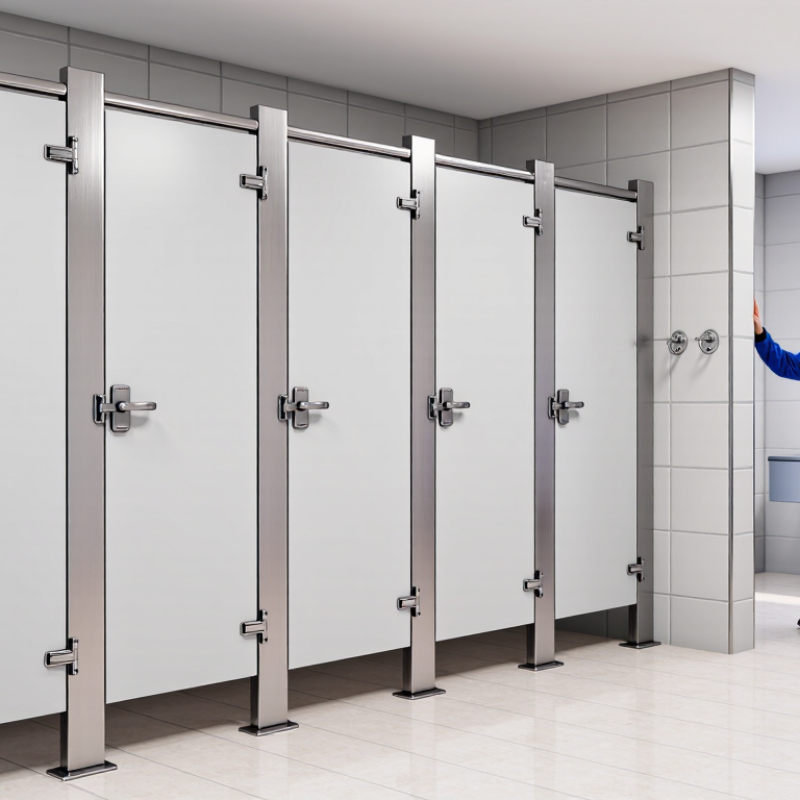
7 Tips for Choosing Public Toilet Partition Hardware?

Understand the Role of Hardware in Public Toilet Partitions

Hardware does more than hold a public toilet partition together. It controls movement, privacy, safety, and maintenance in busy washrooms. A weak hinge can leave a door sagging after months of repeated use. A poorly chosen latch may frustrate users, especially when hands are wet. During site inspections, small fittings often reveal larger installation problems. Loose screws, sharp edges, and uneven gaps deserve immediate attention. Hardware should match the panel material, door weight, cleaning routine, and expected traffic.

Tip: Check load ratings, corrosion resistance, and adjustment options before selecting hinges or brackets. Stainless steel or protected metal usually handles moisture better. Surface quality still matters. Ask for test data, installation instructions, and replacement availability. These details support reliable decisions more than appearance alone. A partition can look excellent on opening day and still perform poorly six months later. That possibility is easy to overlook.

Tip: Test the complete door assembly, not separate components. The latch should engage smoothly, the door should return without slamming, and the indicator should remain visible. Choose fasteners that suit the wall and partition core. Incorrect anchors can loosen when panels are repeatedly pulled. Maintenance staff also need access to hinges and locks. I have seen attractive installations become difficult to service because clearance was ignored. Rechecking the layout before fabrication may feel excessive. It often prevents expensive corrections.

Choose Durable Materials for High-Traffic Environments

7 Tips for Choosing Public Toilet Partition Hardware?

In high-traffic restrooms, durable materials matter more than attractive finishes. Stainless steel hardware resists frequent contact, moisture, and repeated cleaning. Solid-grade hinges usually perform better than thin, decorative alternatives. Water finds weak points. Check screws, brackets, and fasteners for corrosion resistance before installation.

Phenolic compact laminate and high-density polyethylene panels can handle heavy daily use. Their surfaces resist impact, moisture, and many commercial cleaning routines. Match the hardware to the panel weight and thickness. A strong latch can still fail when poorly supported. Ask for tested load data and maintenance guidance from qualified suppliers.

I once saw a busy restroom with excellent panels and weak door brackets. The panels survived, but loose hardware created constant repairs. That mistake changed my selection process. I now inspect hinge cycles, edge protection, and anchor strength together. Test the hinge. Open and close a sample door repeatedly, then check alignment, noise, and loosened fasteners. No material is perfect, especially when cleaning chemicals, humidity, and careless use combine. Choose parts that workers can inspect and replace without damaging the partition.

7 Tips for Choosing Public Toilet Partition Hardware? – Choose Durable Materials for High-Traffic Environments

No. Selection Tip Recommended Material or Feature Relevant Performance Data Why It Matters in High-Traffic Facilities Practical Inspection or Specification Check
1 Prioritize corrosion resistance Use 304 stainless steel for general indoor facilities; consider 316 stainless steel for coastal, poolside, or frequently wet locations. Stainless steel contains chromium that forms a passive protective surface. Grade 316 includes molybdenum, which generally improves resistance to chloride exposure compared with 304. Moisture, cleaning chemicals, and salts can cause staining, pitting, or premature failure of hinges, brackets, locks, and fasteners. Confirm the stainless-steel grade, finish, and compatibility of all connected fasteners. Avoid mixing dissimilar metals where galvanic corrosion may occur.
2 Choose heavy-duty hinges Select adjustable, self-closing hinges with a load rating suitable for the partition door size and weight. A self-closing hinge should return the door reliably after opening. Adjustable models allow the closing speed and alignment to be corrected during maintenance. Doors in busy restrooms may be opened and closed hundreds of times per day. Weak hinges can sag, scrape, or leave doors unsecured. Check the manufacturer’s tested door-weight and width limits, adjustment range, cycle testing, mounting method, and replacement availability.
3 Use tamper-resistant fasteners Specify security-head screws or bolts made from corrosion-resistant stainless steel, with suitable anchors for the wall or floor substrate. Security fasteners require a matching tool for removal. Correct anchors must be selected for concrete, masonry, metal framing, or other substrates. Vandalism, loosening, and unauthorized removal are more likely in unsupervised public areas. Verify the drive type, fastener diameter, embedment depth, anchor capacity, and accessibility for authorized maintenance staff.
4 Select durable latch and indicator hardware Use a robust occupancy latch with a clear vacant/occupied indicator, emergency-release function, and replaceable internal components. The indicator should be visible from the corridor, while the emergency release should permit authorized access without damaging the door. Latches are frequently operated and are essential for privacy, accessibility, and emergency response. Test operation with the door both aligned and slightly loaded. Confirm that the emergency-release method is documented and accessible to facility personnel.
5 Match brackets to the partition system Use rigid wall, pilaster, headrail, and floor brackets designed for the panel thickness and system configuration. Common partition panels may use compact laminate, solid phenolic, plastic laminate, stainless steel, or powder-coated metal; fixing details differ by material. Poorly matched brackets can allow movement, create stress concentrations, and cause fasteners to pull out of the panel. Confirm panel thickness, bracket dimensions, fixing-hole locations, allowable loads, and whether the support is fixed to a structural substrate.
6 Consider cleaning and chemical exposure Choose smooth, non-porous finishes with concealed or protected joints and hardware that is compatible with the planned cleaning chemicals. Frequent exposure to chlorine-based cleaners, acids, alkalis, or abrasive products can damage coatings and some metals. Easy-to-clean surfaces reduce soil retention and help maintenance teams sanitize high-touch areas without accelerating corrosion or finish failure. Request the care instructions, chemical-resistance information, finish limitations, and approved cleaning method before purchase.
7 Plan for accessibility and long-term maintenance Specify hardware that supports accessible clearances, operable force requirements, visual contrast, emergency access, and replaceable wear parts. Accessibility requirements vary by jurisdiction. Door force, maneuvering clearance, latch usability, and emergency access should be checked against the applicable local code. Accessible and maintainable hardware improves usability while reducing downtime and the cost of replacing complete assemblies. Keep spare hinges, latches, fasteners, and indicator parts. Record inspection intervals and verify compliance with the project’s accessibility and building regulations.

Note: Material selection, load ratings, cleaning compatibility, and accessibility requirements should be verified against the project specifications, applicable building codes, and the hardware manufacturer’s technical documentation.

Evaluate Corrosion Resistance and Surface Finishes

When selecting public toilet partition hardware, corrosion resistance matters more than a polished showroom appearance. In busy washrooms, metal meets moisture, cleaning chemicals, fingerprints, and poor ventilation every day. Field inspections often reveal rust beginning around screw heads, hinge edges, and cut surfaces. These small areas are easy to overlook.

Choose materials and finishes suited to the building’s environment. Stainless steel generally performs well, but its grade and manufacturing quality still matter. Powder coating can provide color and protection, while electroplated finishes create a smoother decorative layer. However, a beautiful surface is not automatically a durable one. Ask suppliers about salt-spray testing, coating thickness, cleaning-agent compatibility, and warranty conditions. Test results should support the claims.

Check the details.

Rounded edges reduce residue buildup. Sealed joints limit water entry. Concealed fasteners may improve appearance, but they can make inspection and replacement harder. In my experience, hardware lasts longer when staff use neutral cleaners and dry wet surfaces quickly. Harsh chemicals may dull finishes or damage protective layers over time. This is where specifications can become unrealistic. A finish described as “maintenance-free” still needs sensible care. Compare samples under bright light, then inspect them after cleaning and repeated handling. A slightly less glossy finish may hide fingerprints better and remain practical in heavily used facilities.

Match Hardware Types with Partition Design and Usage

7 Tips for Choosing Public Toilet Partition Hardware
Match Hardware Types with Partition Design and Usage

Choose hardware that matches the partition material, thickness, and edge detail. Solid plastic, compact laminate, and powder-coated panels need different fixing methods. A bracket designed for one system may loosen on another. Check the panel manufacturer’s installation data before ordering.

High-traffic washrooms need strong hinges, reliable latches, and impact-resistant brackets. Stainless steel hardware suits humid rooms and frequent cleaning. In dry areas, coated steel can offer practical value. Select concealed fixings where vandal resistance matters. Avoid sharp edges near busy entrances. Small details matter.

Privacy-focused layouts may require longer door returns or adjustable hinges. Floor-to-ceiling partitions need secure headrail connections, while ceiling-hung designs need accurately positioned support points. Accessible cubicles require hardware that supports easy operation and local accessibility requirements. Leave enough clearance around handles and latches. Test it in place.

Cleaning routines also influence the choice. Smooth surfaces reduce trapped moisture and simplify daily wiping. Tamper-resistant screws can protect public fixtures, but they may slow maintenance. That trade-off deserves attention. A site mock-up can reveal sagging doors, awkward latch positions, or weak wall anchors before installation. Even experienced teams miss these issues sometimes. Review the hardware after several weeks of use, not only on opening day.

Check Safety, Accessibility, Installation, and Maintenance Requirements

7 Tips for Choosing Public Toilet Partition Hardware

Choosing public toilet partition hardware requires more than matching finishes. Begin with safety: select rounded pulls, concealed fixings, tamper-resistant screws, and emergency-release indicators. Avoid sharp projections. Check that hinges, latches, and coat hooks tolerate repeated impact. A practical site check includes opening every door several times, not just inspecting the sample.

Accessibility needs measurable decisions. Where applicable, follow the 2010 ADA Standards for operable parts, including one-hand use without tight grasping, pinching, or twisting. Confirm door clearances, pull locations, and accessible stall hardware before drilling. Installation depends on wall strength, anchor type, moisture exposure, and partition alignment. Do not trust a universal screw pack. Stainless fasteners may perform better in humid washrooms, but they still need compatible substrates and correct torque.

Maintenance should be planned before purchase. Choose hardware that cleaners can reach without dismantling the partition. Keep spare latches, hinge pins, and fasteners on site. The WHO/UNICEF JMP 2023 update reported that 3.5 billion people lacked safely managed sanitation in 2022, highlighting the continuing importance of dependable facilities. Inspection logs should record loose hardware, corrosion, sharp edges, and failed emergency releases. A perfect checklist is unrealistic. I would still test one busy cubicle after installation, because drawings rarely show real misuse.

7 Tips for Choosing Public Toilet Partition Hardware: Check Safety, Accessibility, Installation, and Maintenance Requirements

These ADA 2010 reference values help teams evaluate hardware locations, door operation, accessible clearances, and grab-bar compatibility. Always confirm the current local building code and project-specific requirements before installation.

  • Safety: Choose hardware with smooth edges, secure locking, and no exposed points that could cause injury.
  • Accessibility: Keep door openings, controls, and latches within accessible reach and operating limits.
  • Strength: Verify that hinges, brackets, and fasteners are suitable for the partition material and expected use.
  • Corrosion resistance: Select finishes appropriate for humid, frequently cleaned restroom environments.
  • Privacy and alignment: Check that hinges, indicators, latches, and coat hooks maintain reliable alignment and clearance.
  • Installation: Follow the hardware manufacturer’s fixing method, substrate requirements, and tightening specifications.
  • Maintenance: Inspect loose fasteners, damaged finishes, sticking latches, and worn hinges at regular intervals.

Reference values shown: 60 in turning space diameter, 32 in minimum door clear opening, 48 in maximum and 15 in minimum accessible reach limits, 5 lb maximum operating force, 1.25–2 in grab-bar diameter, and 5 seconds minimum door-closing time. Sources: ADA Standards for Accessible Design, Sections 304, 309, 404, and 609.

FAQS

Why does hardware matter in public toilet partitions?

Hardware controls door movement, privacy, safety, and maintenance. A weak hinge can cause a door to sag within months.

Which materials suit busy and humid washrooms?

Stainless steel usually resists moisture, frequent contact, and repeated cleaning. Protected steel may work in drier areas. No material is perfect.

How can I match hardware with the partition panel?

Check the panel’s material, thickness, weight, and edge detail. Solid plastic and compact laminate need different fixing methods.

What should I check before selecting hinges and brackets?

Review load ratings, corrosion resistance, adjustment options, and test data. Also check replacement availability and installation instructions.

How should a complete door assembly be tested?

Open and close a sample door repeatedly. Check alignment, noise, latch engagement, return speed, and loose fasteners.

What problems can incorrect fasteners cause?

Incorrect anchors may loosen when users pull the doors repeatedly. Match fasteners with the wall and partition core.

How can hardware support easier maintenance?

Leave working clearance around hinges and locks. Choose parts workers can inspect and replace without damaging the partition.

What hardware details improve privacy and accessibility?

Adjustable hinges can improve door returns and alignment. Leave enough clearance around handles and latches for comfortable operation.

Should hardware be reviewed after installation?

Yes. Inspect it after several weeks of use, not only on opening day. Small gaps and loose screws may appear later.

What installation mistake is easy to overlook?

Attractive panels can hide weak brackets or poorly placed anchors. I once underestimated service clearance, and repairs became unnecessarily difficult.

Conclusion

Choosing the right Public Toilet Partition Hardware is essential for creating restroom facilities that are safe, durable, and easy to maintain. Hardware supports the stability, privacy, and daily performance of partition systems, so selection should begin with the restroom’s traffic level and usage requirements. Strong materials such as stainless steel or other suitably durable options can help withstand frequent use, while corrosion-resistant finishes protect components from moisture, cleaning chemicals, and humidity. The finish should also complement the partition design and maintain a clean appearance over time.

It is equally important to match hinges, latches, brackets, handles, and supports with the partition style and installation layout. Consider smooth operation, user safety, accessibility, and compliance with applicable building requirements. Reliable hardware should be easy to install, adjust, inspect, and replace when necessary. Finally, a practical maintenance plan, including routine cleaning and checks for loose or damaged parts, can extend service life and reduce repair costs. By balancing durability, function, appearance, and maintenance needs, facility managers can choose hardware that performs consistently in demanding public environments.

Ethan

Ethan

Ethan is a dedicated marketing professional with a strong understanding of the company’s products, customers, and industry landscape. With a practical, research-driven approach, he transforms complex product features into clear, useful insights that help readers make informed decisions. Ethan......